| Count | Charge | Statute |
|---|---|---|
| 1 | Possession of a machine gun | G.L. c. 269, § 10(c) |
| 2 | Possession of an assault-style weapon | G.L. c. 140, § 131M |
| 3–5 | Possession of a silencer (three counts) | G.L. c. 269, § 10A |
| 6 | Possession of a firearm | G.L. c. 269, § 10(h) |
| 7 | Possession of a 3D printer for firearm manufacturing | G.L. c. 140, § 121D |
| 8 | Possession of an untraceable firearm | G.L. c. 140, § 121C |
| 9 | Possession of an incendiary material | G.L. c. 266, § 102(a) |
| 10 | Unlawful manufacturing of fireworks without a license | G.L. c. 148, § 12 |
Statute links go to the Massachusetts Legislature’s online General Laws. The wording of each count in the indictment controls; this table is a summary.
Who is prosecuting
The case is prosecuted by the Massachusetts Attorney General’s Office, not the Essex County District Attorney. It began in Salem District Court in December 2025 and moved to the Superior Court when the indictment was returned.
How the case was announced
The Attorney General’s Office announced the arraignment in a press release on mass.gov in December 2025,
under a headline that referred to possession of materials to Create Explosive Devices
[Exhibit 5].
Exhibit 5
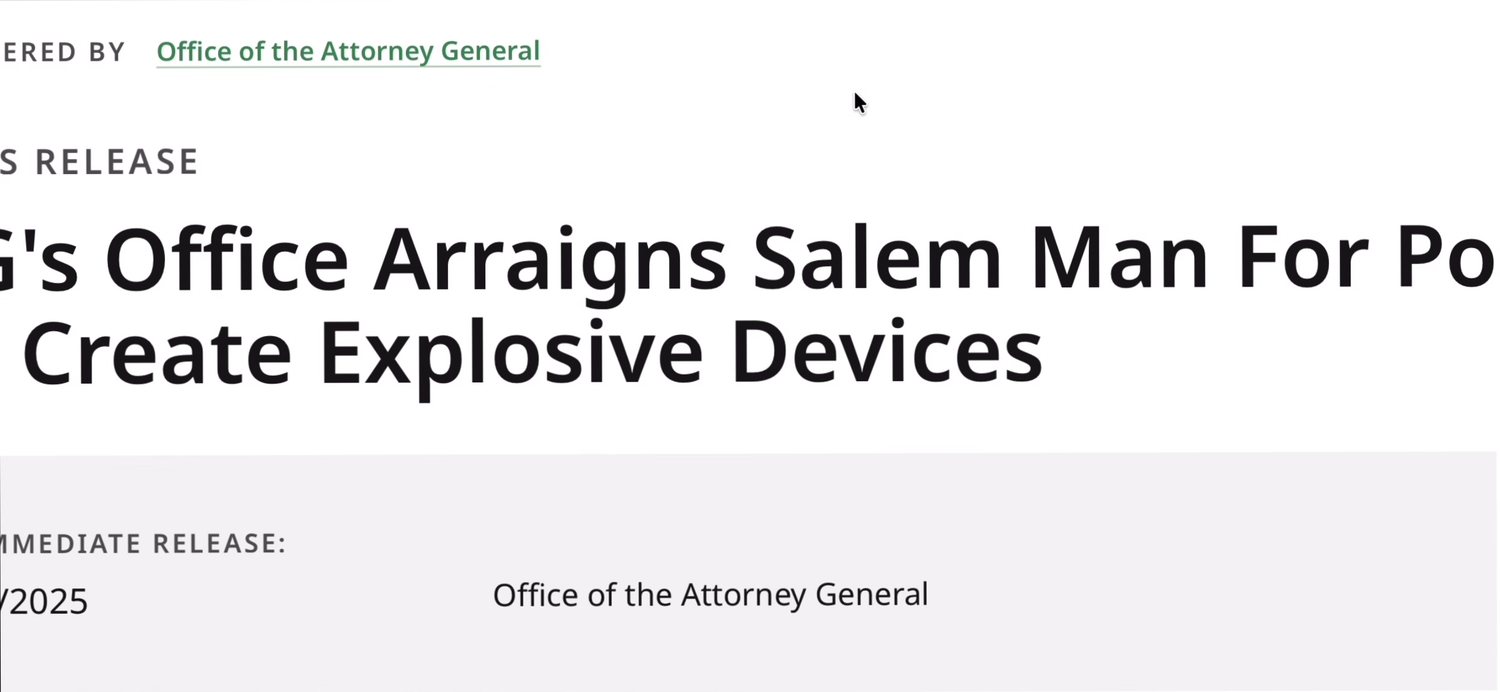
The indictment returned three months later does not use that description as the name of any count. The counts that concern chemicals are count 9, possession of an incendiary material, and count 10, manufacturing fireworks without a license. The other eight concern firearms and firearm-related items.
From two charges to ten
The case did not begin with ten counts. The Trial Court’s online docket for the case filed on December 23, 2025, the day of the arraignment, lists two charges against Mr. Gordon, both felonies with an offense date of December 22, 2025 [Exhibit 7]:
- Possession of an incendiary device (docket entry:
INCENDIARY DEVICE, CHEM/BIO/NUCLEAR WEAPON, POSSESS
), G.L. c. 266, § 102(a). - Unlicensed sale or possession of an assault weapon, G.L. c. 140, § 131M.
Exhibit 7
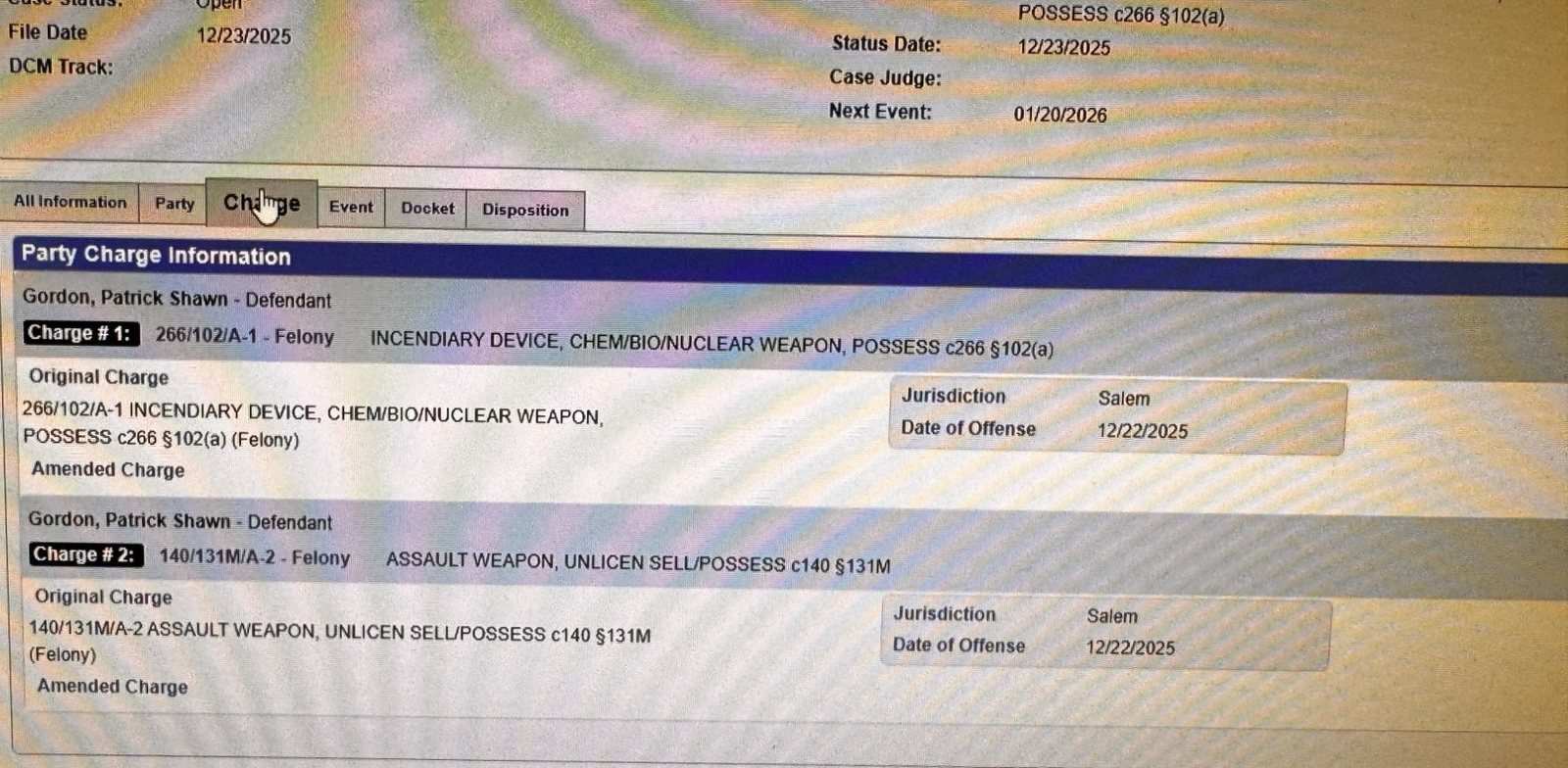
The court name and docket number are outside the frame of the photograph. The file date and the next event shown, January 20, 2026, match the Salem District Court arraignment and probable-cause hearing dates in the timeline.
| Date | Document | Offenses named |
|---|---|---|
| Dec. 22, 2025 | Probable-cause-for-arrest statement, p. 1 | Four: firearm without a license, assault-style firearm, silencer or parts, incendiary device or material |
| Dec. 23, 2025 | Court docket, charge tab (Exhibit 7) | Two: incendiary device, assault weapon |
| Mar. 30, 2026 | Indictment ESCR2026-83 | Ten counts, listed above |
Both docket charges carry through to the indictment, as counts 9 and 2. The other eight counts (machine gun, three silencer counts, firearm, 3D printer, untraceable firearm, and manufacturing fireworks) do not appear on the December docket.
How the number of charges can change
In Massachusetts a felony case usually starts with a complaint in District Court, issued at the time of an arrest. The prosecutor may then present the case to a grand jury, which sits in secret and hears the evidence the prosecutor presents. The grand jury is not limited to the charges in the complaint: it may indict on any offense for which it finds probable cause. An indictment moves the case to the Superior Court and replaces the District Court complaint.
That is what happened here. Adding charges at the indictment stage is permitted, and it is common. It also means that the eight added counts have not been tested in any public hearing: according to Invention Incarnate, the probable-cause hearing set for January 20, 2026 was continued without evidence being taken, and what the grand jury heard is not public. Whether the evidence supports each count is a question the defense can raise in the Superior Court.
The arrest statement and the indictment compared
The Commonwealth’s probable-cause-for-arrest statement, written at the time of the arrest in December 2025, names four offenses: possession of a firearm without a license (G.L. c. 269, § 10(a)), possession of an assault-style firearm (c. 140, § 131M), possession of a silencer or parts (c. 269, § 10A), and possession of an incendiary device or material (c. 266, § 102(c)) (statement, p. 1).
The indictment charges ten counts. It adds possession of a machine gun, a 3D printer for firearm manufacturing, an untraceable firearm, and manufacturing fireworks without a license; it charges three silencer counts; and its firearm and incendiary counts cite different subsections (§ 10(h) and § 102(a)); the December docket already cited § 102(a). The seven pages of the arrest statement in hand describe AR-style receiver parts, a buffer tube, a pistol brace, what the statement calls flash powder, and a list of chemicals and fuse. They do not describe the seizure of a silencer, a 3D printer or a machine gun. The statement says it does not contain every detail, and the evidence presented to the grand jury is not public.
What is not charged
The surveillance of December 18, 2025 was set up, according to the Commonwealth’s own statement, in anticipation of Mr. Gordon bringing large-capacity magazines into Massachusetts. No count of the indictment charges possession or transport of magazines, and the statement reports no magazines among the items found in the search. See What happened.
Presumption of innocence. An indictment is a formal accusation. It is not evidence and not a finding. Patrick Gordon is presumed innocent of each of these counts.